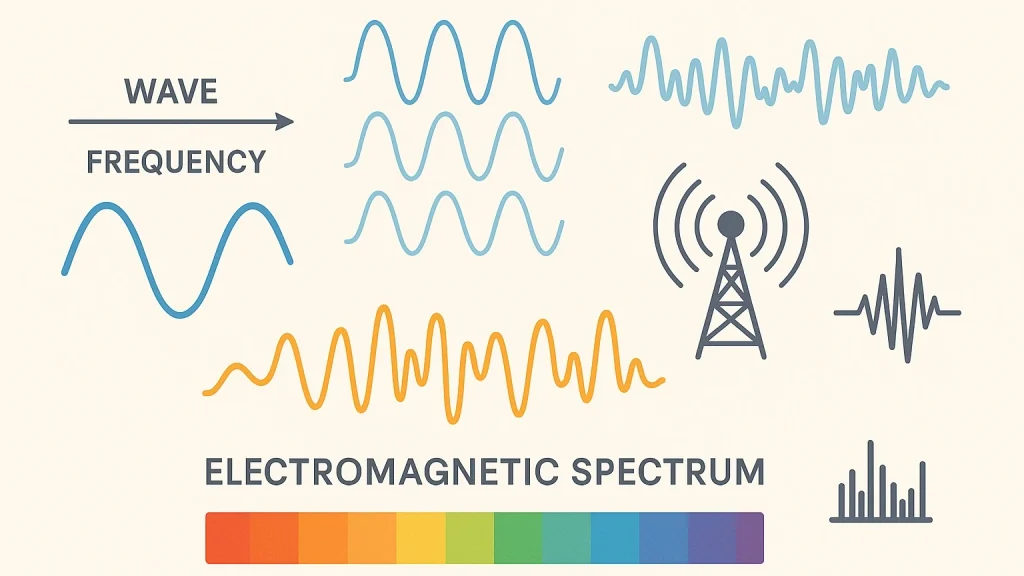
Frequency is one of those scientific concepts that quietly surrounds us every day. We hear it in music, encounter it in radio and television signals, depend on it in electrical systems, and experience it through the repeated movements of machines and natural phenomena. Although the word may sound technical, the basic idea behind frequency is surprisingly simple: frequency describes how often something happens within a certain amount of time.
From the vibration of a guitar string to the operation of a smartphone, frequency helps explain how many familiar things work. Understanding it gives us a new way of looking at the world because it connects sound, light, electricity, communication, technology, and even biological processes through a single idea.
What Is Frequency?
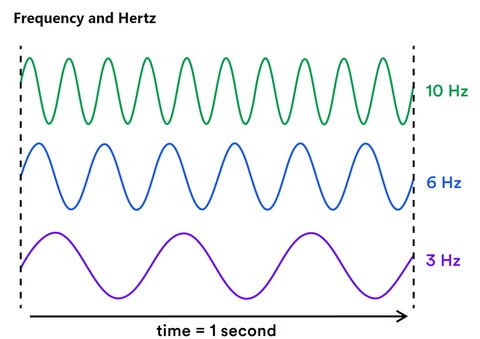
In science, frequency refers to the number of complete cycles or repetitions of an event that occur during a unit of time. It is commonly measured in hertz (Hz). One hertz means that something happens once per second. Ten hertz means it happens ten times per second, while 1,000 hertz means it happens one thousand times per second.
This idea can be applied to almost any repeating event.
Imagine a pendulum swinging from one side to the other and back again. If it completes one full swing cycle every two seconds, its frequency is relatively low. If another pendulum completes ten cycles every second, its frequency is much higher.
Frequency is closely related to another concept called period. The period tells us how long one complete cycle takes, while frequency tells us how many cycles occur in a given amount of time. They are mathematical opposites:
Frequency = 1 ÷ Period
This relationship becomes extremely useful when studying waves and repeating processes.
Frequency and Sound
One of the easiest ways to experience frequency is through sound.
Sound is produced when something vibrates. When a guitar string is plucked, for example, the string moves back and forth rapidly. These vibrations disturb the surrounding air and create a sound wave that eventually reaches our ears.
The frequency of the vibration determines the pitch we hear.
A low-frequency vibration produces a low-pitched sound, such as the deep note of a bass instrument. A high-frequency vibration produces a high-pitched sound, such as the sharp note of a whistle.
Human hearing is limited to a particular range of frequencies. Generally, young people with healthy hearing can hear frequencies from about 20 Hz to 20,000 Hz, although the exact range varies from person to person and tends to decrease with age.
This explains why some sounds are audible to certain people but not others.
Dogs and some other animals can hear frequencies significantly higher than humans. Technologies such as ultrasonic imaging also make use of frequencies beyond normal human hearing.
Frequency therefore helps define the acoustic world around us, even when we cannot consciously identify it.
Frequency in Music
Music provides another fascinating example.
Every musical note corresponds to a particular fundamental frequency. For instance, the commonly used concert pitch for the note A above middle C is approximately 440 Hz. This means the fundamental vibration associated with that note occurs about 440 times per second.
However, real musical instruments are more complicated than producing a single frequency. When a piano string, guitar string, or violin string vibrates, it produces a fundamental frequency along with additional frequencies called harmonics.
These harmonics help determine the character or tone of an instrument.
This is why the same musical note can sound different when played on a piano and a violin. Both may produce the same fundamental frequency, but the mixture and relative strength of their harmonics are different.
Frequency is therefore not simply about how high or low a note sounds. It is also part of what gives music its richness, personality, and emotional quality.
Frequency and Radio Communication
Modern communication systems depend heavily on frequency.
Radio stations transmit information using electromagnetic waves. Different stations operate at different frequencies so that their signals can be distinguished.
When you tune a radio to a particular station, you are essentially selecting a particular frequency range. The radio receiver detects electromagnetic energy around that frequency and converts the encoded information into an audio signal.
The same basic principle is used in many wireless technologies.
Television broadcasting, mobile phones, Wi-Fi, Bluetooth, satellite communication, and other wireless systems all rely on electromagnetic frequencies.
Different frequencies have different characteristics. Some can travel long distances effectively, while others can carry large amounts of information or interact with objects in particular ways.
This is why the electromagnetic spectrum is divided into different frequency bands for different applications.
Without frequency management, modern wireless communication would become extremely difficult because countless signals could interfere with one another.
Frequency in Electricity
Frequency is also essential to the electrical systems that power modern life.
In alternating-current electricity, the direction of electrical current changes periodically. The number of these cycles occurring each second is the frequency of the electrical supply.
In many countries, household electricity operates at either 50 Hz or 60 Hz.
This means the alternating electrical waveform completes 50 or 60 cycles per second, depending on the electrical system.
Although this process is invisible, it affects appliances and electrical equipment. Motors, transformers, clocks, and other devices are designed to operate according to particular electrical frequencies.
Some digital clocks, for example, can use the frequency of the electrical supply as a timing reference. Electrical engineers also monitor frequency carefully because large power grids must maintain a stable balance between electricity generation and consumption.
A change in grid frequency can indicate that the system is under stress.
Thus, frequency is not merely an abstract measurement. It can be an important indicator of whether an electrical system is operating normally.
Frequency and Light
Frequency becomes even more interesting when we look at light.
Visible light is part of the electromagnetic spectrum. Different colors of visible light correspond to different frequencies.
Red light has a lower frequency than violet light. As frequency increases across the visible spectrum, the perceived color changes from red through orange, yellow, green, and blue toward violet.
This means color is connected to the frequency of electromagnetic radiation.
The relationship between frequency and wavelength is particularly important. In a vacuum, electromagnetic waves travel at the speed of light, and frequency and wavelength are related by:
c = fλ
Here, c represents the speed of light, f represents frequency, and λ represents wavelength.
As frequency increases, wavelength decreases, provided the wave is traveling at the same speed.
This principle extends beyond visible light. Radio waves, microwaves, infrared radiation, ultraviolet radiation, X-rays, and gamma rays all occupy different portions of the electromagnetic spectrum.
Frequency in Technology
Our everyday devices are filled with systems that depend on frequency.
Computer processors operate according to clock frequencies. Although processor performance cannot be judged by clock speed alone, the clock provides a fundamental timing mechanism for coordinating operations.
Smartphones contain radio systems that communicate using specific frequency bands. Wi-Fi routers use electromagnetic frequencies to exchange data with devices. Bluetooth also relies on radio-frequency communication.
Even screens involve rapidly changing electrical signals and refresh processes. A display’s refresh rate, measured in hertz, describes how many times per second the image can be refreshed.
For example, a 60 Hz display can refresh the image up to 60 times per second, while higher refresh rates can produce smoother motion under appropriate conditions.
Frequency is therefore embedded in the technology we use from morning until night.
Frequency in Nature
Frequency is not something humans invented. It is a fundamental feature of many natural processes.
Ocean waves rise and fall in repeating patterns. Earthquakes generate waves with different frequencies. The rotation and vibration of physical systems can be described in terms of frequency.
Even atoms and molecules have characteristic patterns of vibration.
The frequency of these molecular vibrations is important in fields such as chemistry and spectroscopy. Scientists can study how matter interacts with electromagnetic radiation at different frequencies to learn about its composition and structure.
This gives frequency an important role in scientific observation.
Rather than simply seeing or touching an object, researchers can analyze the frequencies associated with it and discover information that might otherwise remain hidden.
Frequency and Human Biology
The human body also contains repeating rhythms.
The heart beats in cycles. Breathing follows a rhythm. Brain activity contains electrical patterns that can be measured using specialized equipment.
Medical technologies can use frequency-related information to study these processes.
For example, electroencephalography, commonly known as EEG, records electrical activity in the brain. Researchers and medical professionals can analyze patterns of brain activity that occur at different frequency ranges.
Heart monitoring also involves analyzing repeating electrical signals and rhythms.
These examples demonstrate that frequency is not limited to machines or physical waves. It can also help describe biological activity.
Frequency and Everyday Measurements
We encounter frequency more often than we may realize.
A car engine operates through repeated cycles. A fan rotates at a particular rate. A washing machine completes programmed cycles. A vibrating phone produces mechanical oscillations. A speaker moves back and forth to create sound.
Even when we do not calculate frequency directly, we often observe its effects.
When a fan spins faster, its rotational frequency increases. When a musical instrument plays a higher note, the vibration frequency increases. When a display has a higher refresh rate, it can update images more frequently.
In each case, the underlying idea remains the same: frequency measures repetition over time.
Why Understanding Frequency Matters
Learning about frequency provides more than a scientific definition. It gives us a framework for understanding how different systems behave.
It helps explain why sounds have different pitches, why colors differ, how radio stations communicate, how electricity operates, and how electronic devices keep track of time.
It also reveals connections between seemingly unrelated subjects.
Sound and radio signals may appear completely different, yet both can be described using waves and frequency. A vibrating guitar string and an electrical alternating-current system seem unrelated, but both involve repeating cycles. Light and radio waves occupy different parts of the electromagnetic spectrum, but they are governed by the same fundamental principles.
Frequency acts as a bridge between these subjects.
Conclusion
Frequency is one of the simplest yet most powerful ideas in science. At its core, it answers a basic question: How often does something repeat?
That question leads into a vast range of phenomena.
We hear frequency when we listen to music. We depend on it when using wireless devices. We encounter it in household electricity, computer systems, television signals, light, machinery, and biological rhythms.
Much of the modern world operates through processes that repeat too quickly—or too slowly—for us to notice directly. Frequency allows us to measure and understand those processes.
Once we begin paying attention to it, frequency appears everywhere. The hum of an appliance, the note of a musical instrument, the signal from a mobile phone, the flicker or refresh of a display, and even the rhythms of natural systems can all be understood through patterns of repetition.
In this sense, frequency is more than a scientific measurement. It is a way of recognizing the hidden rhythms that organize the physical world.
From the smallest vibrations to the signals connecting continents, frequency quietly shapes the world around us. And although we may rarely think about it, nearly every moment of modern life contains a rhythm waiting to be measured.