Waves are among the most important and fascinating phenomena in the world around us. We hear waves when a speaker produces music, see their effects when sunlight reaches our eyes, and depend on them whenever a phone sends a message across a network. Waves can travel through air, water, solid materials, and even empty space. They carry energy, transmit information, and connect systems that may be separated by enormous distances.
Signals, meanwhile, give waves a purpose. A wave can carry information about a voice, a photograph, a television program, or a scientific measurement. Sound is one of the most familiar examples because it is a wave that allows humans and many animals to communicate with the world around them.
Although waves, signals, and sound appear in countless forms, they are connected by a common principle: patterns that change over time and space can carry energy or information. Understanding these concepts helps explain everything from musical instruments to wireless communication and modern digital technology.
What Is a Wave?
A wave can be understood as a disturbance or variation that travels from one location to another. Importantly, the material through which a wave travels does not necessarily move along with the wave over long distances. Instead, energy is transferred from one point to another.
Consider dropping a small stone into a calm pond. Ripples spread outward from the point where the stone enters the water. The water itself mostly moves up and down, while the disturbance travels outward.
This simple example illustrates an important feature of waves: energy can move without the entire medium traveling with it.
Waves can take many forms. Ocean waves are mechanical waves because they require a physical medium. Sound waves are also mechanical. Electromagnetic waves, such as light and radio waves, are different because they can travel through empty space.
The Basic Properties of Waves
Several properties help scientists describe waves.
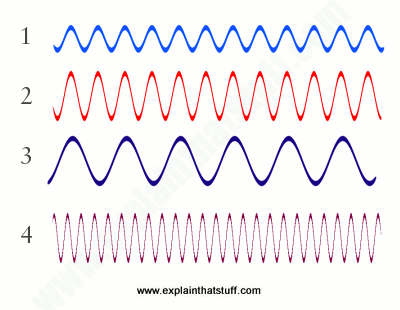
Wavelength is the distance between corresponding points on successive waves, such as the distance from one crest to the next.
Frequency describes how many complete cycles occur each second and is measured in hertz.
Amplitude describes the size or strength of a wave’s variation.
Speed describes how quickly the wave travels through a particular medium or environment.
These properties are related. For many waves, the relationship between speed, frequency, and wavelength can be expressed as:
Wave speed = frequency × wavelength
This equation demonstrates how changing one property can affect another.
For example, if a wave travels at a constant speed and its frequency increases, its wavelength must decrease.
These concepts are not limited to physics classrooms. They help explain musical notes, radio communication, earthquakes, light, and countless technological systems.
Mechanical Waves
Mechanical waves require a medium through which they can travel.
Sound provides a familiar example. When an object vibrates, it causes nearby particles in the surrounding material to move. Those particles affect neighboring particles, allowing the disturbance to travel.
The medium could be air, water, wood, metal, or another material.
This explains why sound behaves differently in different environments. Sound can travel through solids and liquids as well as gases. In general, it travels faster through many solids than through air because the particles can interact strongly with one another.
Mechanical waves can also be classified according to how particles move relative to the direction of the wave.
In a longitudinal wave, particles move back and forth in roughly the same direction that the wave travels. Sound in air is a common example.
In a transverse wave, particles move perpendicular to the direction of propagation. Waves traveling along a stretched string provide a simple illustration.
Understanding these distinctions helps scientists describe everything from vibrations in materials to seismic activity.
The Science of Sound
Sound begins with vibration.
When you strike a drum, the drumhead vibrates. When you speak, vibrations produced by structures in your vocal system create changes in air pressure. When a guitar string is plucked, it vibrates and transfers energy to the surrounding air.
These pressure variations travel outward as a sound wave.
When the wave reaches our ears, it causes structures inside the ear to vibrate. The auditory system converts these physical vibrations into signals that the brain interprets as sound.
This process is remarkable because a physical disturbance in the air becomes a meaningful experience.
We do not simply hear vibrations. We hear voices, melodies, warnings, laughter, footsteps, and environmental sounds.
Frequency and Pitch
Frequency plays a major role in how we perceive sound.
A sound wave with a higher frequency is generally perceived as having a higher pitch. A lower frequency generally produces a lower pitch.
For example, the sound of a large bass drum tends to contain strong low-frequency components, while a small whistle may contain much higher frequencies.
Human hearing covers a limited range of frequencies. The commonly cited range for healthy young human hearing is approximately 20 Hz to 20,000 Hz, although individual hearing varies and the upper limit generally decreases with age.
Some animals hear frequencies beyond this range. Dogs, bats, and other species can detect ultrasonic sounds that humans cannot hear.
This difference demonstrates that sound is a physical phenomenon, while hearing is a biological interpretation of that phenomenon.
Amplitude and Loudness
Frequency is not the only property that matters.
Amplitude also affects our perception of sound. Larger variations in air pressure generally correspond to greater sound intensity, which we perceive as louder sound.
This is why increasing the volume of a speaker produces a stronger auditory experience.
However, loudness is a perceptual phenomenon and is not identical to physical amplitude. Human hearing is sensitive to different frequencies in different ways.
Sound levels are commonly expressed using decibels (dB), a logarithmic measurement used to describe sound intensity or related quantities.
Very loud sounds can damage hearing, particularly when exposure is intense or prolonged. This is why hearing protection is important in environments such as concerts, construction sites, factories, and areas with powerful machinery.
Signals: Waves Carrying Information
A wave becomes especially useful when it can carry information.
A signal is a representation of information that changes in a way that can be transmitted, processed, or interpreted.
Consider human speech. Your voice produces sound waves containing information. A microphone converts those sound waves into an electrical signal. That signal can then be processed, transmitted, stored, or converted into digital data.
At the receiving end, the information can be transformed back into an electrical signal and eventually into sound.
This basic process lies behind telephone conversations, radio broadcasts, recording systems, and many other technologies.
The key idea is that information can be encoded into patterns.
Analog and Digital Signals
Signals can be broadly described as analog or digital.
An analog signal varies continuously. Traditional vinyl records and some older forms of audio recording provide examples of systems that represent sound through continuous physical variations.
Digital signals represent information using discrete values. Computers commonly use binary representations involving 0s and 1s.
When sound is recorded digitally, a microphone first converts acoustic vibrations into an electrical signal. An analog-to-digital converter then takes measurements of that signal at regular intervals and represents those measurements numerically.
The resulting data can be stored, copied, transmitted, and processed by digital systems.
Digital technology has transformed sound because information can be manipulated with extraordinary precision. Audio can be edited, compressed, transmitted through networks, and reproduced on devices around the world.
Waves in Wireless Communication
Waves are also responsible for much of modern wireless communication.
Radio waves are electromagnetic waves. Unlike sound waves, they do not require air or another material medium to travel.
Mobile phones, Wi-Fi systems, radio broadcasting, satellite communications, and many other technologies use electromagnetic waves to transmit information.
A transmitter generates a signal, while a receiver detects and interprets it.
The information may be encoded by changing properties of the electromagnetic wave. Different communication systems use different techniques and frequency ranges.
This is why a smartphone can communicate with a distant cell tower without requiring a physical cable between them.
Wireless communication is essentially the controlled movement of information through electromagnetic waves.
Interference and Noise
Real-world signals are rarely perfect.
As a signal travels, it may encounter unwanted disturbances known as noise. Other signals can also interfere with the original transmission.
Imagine trying to hear a quiet conversation in a crowded room. The speaker’s voice is the desired signal, while the surrounding conversations are noise.
Communication systems face similar challenges.
Engineers design systems to improve signal quality, reduce interference, and recover information even when transmissions are imperfect.
Digital systems have an advantage in some situations because information can often be reconstructed accurately even when the received signal contains some errors.
Techniques such as error detection and correction help modern networks maintain reliable communication.
Waves in Nature
Waves are not merely technological tools. They are fundamental to nature.
Ocean waves transport energy across water. Seismic waves travel through Earth’s interior during earthquakes. Light from the Sun travels through space and provides the energy necessary for life on Earth.
Electromagnetic waves also allow astronomers to study objects billions of light-years away.
Different wavelengths reveal different aspects of the universe. Radio telescopes, infrared instruments, visible-light telescopes, X-ray observatories, and other systems observe different regions of the electromagnetic spectrum.
In this way, waves become a form of cosmic information.
The universe is constantly sending signals toward us, and scientific instruments allow us to interpret them.
Waves and Modern Technology
Almost every modern technological system has some connection to waves or signals.
Microphones transform sound waves into electrical signals. Speakers perform the reverse process. Cameras detect electromagnetic radiation and convert it into information. Medical imaging systems use different kinds of waves to examine the human body.
Ultrasound uses high-frequency sound waves to create images of internal structures. Radar uses electromagnetic waves to detect objects and measure distances. Fiber-optic communication uses pulses of light to transmit huge amounts of information through thin strands of glass or plastic.
These technologies demonstrate the versatility of waves.
A single scientific concept can become the foundation for communication, medicine, transportation, entertainment, and scientific discovery.
Why Waves Matter
Understanding waves helps us see connections between subjects that might otherwise seem unrelated.
Music depends on sound waves. Mobile communication depends on electromagnetic waves. Earthquake detection depends on seismic waves. Medical imaging can depend on acoustic or electromagnetic phenomena.
The underlying mathematics and physical principles may differ in important ways, but the broader concept remains consistent: waves allow energy and information to move through systems.
They are nature’s way of transmitting change.
Conclusion
Waves are everywhere, from the vibrations of a musical instrument to the electromagnetic signals connecting smartphones across continents. Sound allows us to communicate and experience music. Signals allow information to be encoded, transmitted, stored, and interpreted. Together, these concepts form part of the foundation of modern science and technology.
The next time you hear music, make a phone call, watch a video, see sunlight, or listen to thunder, you are experiencing the effects of waves.
What appears to be an ordinary moment may involve vibrations traveling through air, electrical signals moving through circuits, electromagnetic waves crossing space, or digital information moving through networks.
Waves make these experiences possible.
They are invisible in many of their most important forms, yet their effects are everywhere. They carry energy, transport information, connect distant places, reveal hidden structures, and allow us to experience the world through sound and sight.
To understand waves is therefore to understand one of nature’s most fundamental languages—a language written in patterns of motion, frequency, energy, and change.