Much of the world around us is invisible.
We cannot see the radio signals connecting our phones to distant towers. We cannot see the microwaves heating food in a kitchen. We cannot see the infrared radiation emitted by a warm object or the signals traveling between a wireless router and a laptop. Yet these invisible forms of energy are constantly interacting with our environment and making modern life possible.
Invisible waves are among the most powerful and useful phenomena in nature. They carry energy and information across distances, allow devices to communicate, help doctors examine the human body, and enable scientists to observe objects far beyond our planet. They are so deeply integrated into everyday life that we often notice only their effects rather than the waves themselves.
To understand how invisible waves shape our world, we first need to understand what a wave actually is.
Understanding the Idea of a Wave
A wave can be thought of as a traveling pattern or disturbance that transfers energy from one place to another. Waves can occur in many different forms.
Ocean waves move through water. Sound waves travel through air and other materials. Vibrations can move along a rope or through a solid structure. Electromagnetic waves, such as radio waves and light, can travel through empty space.
Not all waves behave in exactly the same way, but many can be described using properties such as wavelength, frequency, amplitude, and speed.
Wavelength is the distance between corresponding points on repeating waves. Frequency describes how many cycles occur per second. Amplitude relates to the strength or size of a wave.
These characteristics help scientists and engineers understand how waves behave and how they can be used.
The Electromagnetic Spectrum
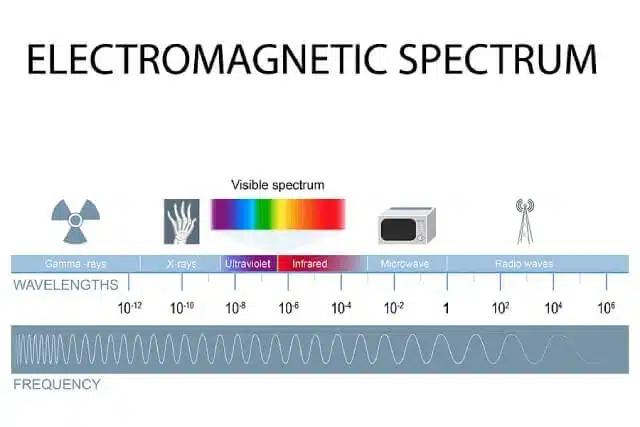
When people hear the phrase “invisible waves,” they often think about electromagnetic waves.
Visible light is only a small portion of the electromagnetic spectrum. Beyond the narrow range detected by human eyes are radio waves, microwaves, infrared radiation, ultraviolet radiation, X-rays, and gamma rays.
All of these are forms of electromagnetic radiation, but they differ in wavelength and frequency.
Radio waves generally have relatively long wavelengths and lower frequencies compared with visible light. Gamma rays have extremely short wavelengths and very high frequencies.
Between these extremes are several other regions of the spectrum, each with different properties and applications.
The fact that humans can see only a tiny portion of this spectrum is important. Our senses provide only a limited window into reality. Technology expands that window by allowing us to detect forms of electromagnetic radiation that our eyes cannot perceive.
Radio Waves Connect the World
Radio waves are among the most important invisible waves in modern society.
When you make a mobile phone call, connect to a wireless network, listen to a broadcast, or use certain forms of remote control, radio-frequency technology is involved.
A transmitter creates an electromagnetic signal. Information is encoded into that signal and transmitted through space. A receiver detects the signal and extracts the information.
This basic principle supports enormous communication networks.
Mobile phones communicate with cellular infrastructure using radio-frequency signals. Wireless routers exchange data with computers and smartphones. Satellites communicate with ground stations through radio systems.
The remarkable feature of radio waves is that they allow information to travel without requiring a physical cable between the transmitter and receiver.
A simple tap on a smartphone can therefore initiate a complicated journey involving antennas, radio waves, computers, networks, and servers.
Wi-Fi and the Invisible Home Network
Inside many homes, invisible waves are constantly moving between devices.
A wireless router communicates with phones, laptops, televisions, tablets, and other connected equipment using radio signals.
The user sees only the result: a webpage loads, a video begins streaming, or a message is delivered.
Behind that simple experience is a continuous exchange of electromagnetic signals.
Wireless communication depends on carefully managed frequencies, signal strength, modulation techniques, antennas, and protocols. Engineers design these systems so that multiple devices can communicate while reducing interference.
The convenience of Wi-Fi therefore rests on a sophisticated interaction between physics and information technology.
Microwaves in the Kitchen
Microwaves are another part of the electromagnetic spectrum with an everyday application.
A microwave oven uses electromagnetic radiation to transfer energy to food. The electromagnetic field interacts with molecules in the food, producing heating through molecular motion and related processes.
The oven’s design confines and distributes the microwave energy within the cooking chamber.
Although the word “microwave” is strongly associated with cooking, microwaves have many other applications.
They are used in radar systems, satellite communications, wireless links, and scientific instruments.
Radar, for example, sends electromagnetic waves toward objects and analyzes returning signals. By studying the reflected waves, a system can determine information such as an object’s distance and movement.
The same broad family of waves can therefore be useful in both a kitchen appliance and sophisticated navigation or sensing technology.
Infrared: The Heat We Cannot See
Infrared radiation is another invisible form of electromagnetic energy.
Warm objects emit infrared radiation. Although our eyes cannot normally see this radiation, specialized sensors can detect it.
Thermal cameras use infrared radiation to create images based on temperature differences. They can reveal warm objects in darkness, help identify overheating electrical components, and assist in industrial inspections.
Infrared technology is also used in remote controls, sensors, communication systems, and scientific instruments.
The everyday remote control is a particularly familiar example. When a button is pressed, the device sends a pattern of infrared light toward a receiver on a television or other appliance.
The light is invisible to our eyes, but the electronic receiver detects it.
This demonstrates an important principle of technology: something does not need to be visible to be useful.
Ultraviolet Radiation
Beyond visible violet light lies ultraviolet radiation.
Ultraviolet waves have higher frequencies than visible light. They are present in sunlight and can have significant effects on living organisms.
Some ultraviolet radiation contributes to sunburn and can damage biological tissue. Excessive exposure can increase health risks, which is why protection from strong ultraviolet radiation is important.
At the same time, ultraviolet radiation has useful applications.
UV light can be used for certain sterilization and disinfection processes, scientific analysis, industrial applications, and specialized lighting.
Again, the same physical phenomenon can have both beneficial and harmful effects depending on how it is used and controlled.
X-Rays and Medical Imaging
X-rays provide one of the most important examples of invisible waves transforming medicine.
X-rays have much higher frequencies than visible light and can pass through many materials that block visible light.
Different tissues and materials absorb X-rays to different degrees. This allows medical imaging systems to create pictures of structures inside the body.
A physician can use an X-ray image to examine bones and identify certain abnormalities without making an incision.
This represents a profound change in medicine.
Instead of relying solely on external observation, doctors can use invisible electromagnetic radiation to look inside the human body.
The principle also has applications beyond medicine. X-ray techniques can be used to inspect industrial components, examine materials, and study objects in scientific research.
Invisible Waves in Astronomy
Invisible waves are equally important for understanding the universe.
Astronomers do not rely only on visible light. They observe the universe across many portions of the electromagnetic spectrum.
Radio telescopes detect radio waves from distant astronomical objects. Infrared observations can reveal objects and regions that are difficult to study using visible light. X-ray observations can reveal extremely energetic phenomena.
Each part of the electromagnetic spectrum provides a different perspective.
This is similar to examining an object using different cameras, each sensitive to different types of information.
By combining observations across multiple wavelengths, scientists can build a much more complete picture of astronomical objects and events.
Invisible waves have therefore expanded our understanding of the universe far beyond what human eyes alone could reveal.
Sound Waves Are Invisible Too
Not all invisible waves are electromagnetic.
Sound is a mechanical wave. Although we cannot see sound waves directly, we experience them constantly.
When a speaker produces music, its surface vibrates and creates pressure variations in the surrounding air. Those variations travel outward and eventually reach our ears.
The human auditory system converts these vibrations into electrical signals that the brain interprets as sound.
Sound waves also have technological applications beyond communication and entertainment.
Ultrasound systems use high-frequency sound waves to examine structures inside the body. Sonar systems use sound waves to detect objects underwater. Industrial systems can use acoustic waves to inspect materials or identify problems.
The world of invisible waves therefore includes both electromagnetic and mechanical phenomena.
GPS and the Signals Above Us
Navigation systems provide another example of invisible waves affecting everyday life.
Global navigation satellite systems use signals transmitted by satellites. A receiver on Earth detects these signals and uses timing information to estimate its position.
When someone uses a smartphone to find a restaurant, navigate a road, or track a journey, invisible electromagnetic signals from satellites and other infrastructure can be part of the process.
The accuracy of the system depends heavily on extremely precise timing.
This illustrates how waves can carry not only messages but also measurements.
A signal does not have to contain a voice or photograph. It can contain information about time, position, distance, and other physical quantities.
The Role of Frequency
Frequency is one of the key concepts that makes all of this possible.
Different technologies use different frequency ranges because waves behave differently at different frequencies.
Frequency determines where electromagnetic radiation falls within the spectrum and influences properties such as wavelength and how the radiation interacts with materials.
In communication systems, frequency helps separate different channels and applications.
In medical and scientific systems, carefully selected frequencies can allow researchers to detect particular physical properties.
Frequency is therefore one of the invisible organizing principles of modern technology.
The Hidden Infrastructure
Perhaps the most fascinating thing about invisible waves is how much infrastructure depends on them.
Behind a smartphone is a network of antennas and base stations. Behind Wi-Fi is a router and a complex global internet infrastructure. Behind satellite navigation is a constellation of satellites and ground-based systems.
Behind medical imaging are carefully engineered sources, detectors, computers, and safety systems.
The waves themselves may be invisible, but the technology built around them is very real.
Modern society has effectively constructed an enormous invisible information