The world around us is filled with movement, communication, and energy transfer. A guitar string vibrates when it is plucked. A speaker moves back and forth to produce music. A smartphone sends information through invisible electromagnetic waves. A machine produces a characteristic hum as its components rotate. Even the human body relies on electrical and mechanical signals to coordinate its activities.
These everyday experiences are connected by three fundamental ideas: signals, sound, and vibration.
Although each term describes something slightly different, they often interact. Vibrations can produce sound. Sound can be converted into electrical signals. Signals can be transmitted through waves. Computers can process those signals and convert them back into sound, images, or instructions.
Understanding the science behind these processes reveals a fascinating hidden world beneath ordinary experiences. What appears to be a simple sound, movement, or wireless connection may actually involve carefully organized patterns of energy and information.
What Is Vibration?
Vibration is repeated motion around an equilibrium position.
A simple example is a spring. If a weight is attached to a spring and pulled downward, the spring stores energy. When released, the weight moves upward and downward repeatedly. The motion gradually decreases because energy is transferred into other forms, such as heat and sound.
Many objects can vibrate.
A guitar string vibrates when plucked. A tuning fork vibrates after being struck. The membrane of a speaker vibrates when an electrical signal reaches it. A phone’s vibration motor moves a small mass to create tactile feedback.
Some vibrations are slow enough for us to see. Others occur so rapidly that they are invisible.
The number of cycles completed per second is called frequency, measured in hertz. A frequency of 100 hertz means that a system completes 100 cycles every second.
Frequency is one of the most important characteristics of vibration because it influences how a system behaves and, in the case of sound, what we hear.
How Vibration Creates Sound
Sound is a direct consequence of vibration.
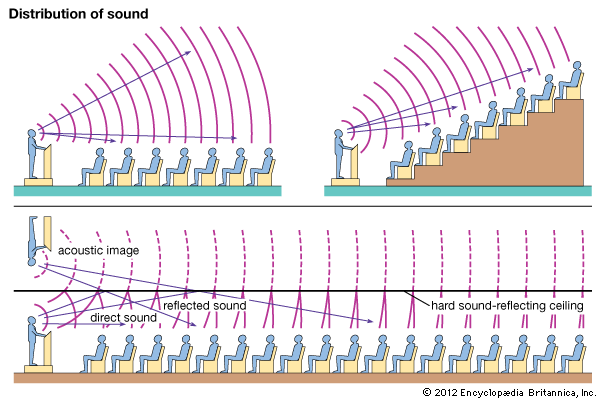
When an object vibrates, it can cause nearby particles in a surrounding medium to move. In air, this creates alternating regions of higher and lower pressure. These pressure variations travel outward as a sound wave.
Imagine striking a drum.
The drumhead moves rapidly back and forth. As it moves outward, it compresses nearby air. As it moves inward, the air pressure decreases. These changes spread through the surrounding atmosphere.
When the resulting wave reaches our ears, it causes the eardrum to vibrate.
The ear transforms this mechanical movement into electrical signals that travel through the nervous system to the brain. The brain then interprets those signals as sound.
In this way, hearing is a chain of physical events:
vibration → pressure variation → wave → ear movement → neural signal → perception
A simple sound therefore involves an impressive sequence of processes.
Frequency and Pitch
Frequency plays a central role in how we experience sound.
A sound with a higher frequency is generally perceived as having a higher pitch. A lower frequency is generally perceived as having a lower pitch.
A bass instrument produces strong low-frequency components, while a whistle can contain much higher frequencies.
Human hearing covers a limited frequency range. A commonly cited range for healthy young human hearing is approximately 20 Hz to 20,000 Hz, although the exact range varies from person to person and generally decreases with age.
Some animals can detect sounds outside this range.
Dogs, for example, can hear higher-frequency sounds than humans. Bats use very high-frequency sounds for echolocation.
These examples demonstrate that sound is a physical phenomenon that exists independently of whether humans can hear it.
Amplitude and Loudness
Frequency determines one important aspect of sound, but it is not the whole story.
Another important property is amplitude.
Amplitude describes the size of a wave’s variation. In sound, larger pressure variations generally correspond to greater sound intensity, which we perceive as louder sound.
A quiet conversation produces relatively small pressure variations, while a powerful speaker can produce much larger ones.
Sound levels are commonly expressed in decibels. Because the decibel scale is logarithmic, an increase in the numerical value does not represent a simple linear increase in physical intensity.
Understanding sound intensity is important for hearing safety. Very loud sounds can damage hearing, especially when exposure is prolonged.
This is why hearing protection is valuable in environments such as factories, construction sites, concerts, and areas with powerful machinery.
Why Different Instruments Sound Different
Frequency also helps explain the character of musical instruments.
Suppose a piano and a violin play the same musical note. They can produce the same fundamental frequency, but they do not sound identical.
The reason is that real instruments generate complex combinations of frequencies.
Along with the fundamental frequency, instruments produce harmonics and other frequency components. The relative strengths of these components contribute to what musicians call timbre.
This is why we can often identify an instrument simply by hearing it.
The physics of vibration therefore contributes directly to musical expression.
Musicians manipulate strings, air columns, membranes, electronic circuits, and other vibrating systems to create particular combinations of frequencies.
Music is, in many ways, organized vibration.
What Is a Signal?
A signal is a changing physical quantity that represents information.
The information could be a sound, image, temperature, location, measurement, or command.
Consider a microphone.
When you speak, sound waves cause a microphone’s diaphragm to move. The microphone converts this mechanical movement into an electrical signal.
The signal can then be amplified, stored, processed, transmitted, or converted into digital data.
At another location, a speaker can convert the processed signal back into mechanical vibration, producing sound.
The important point is that information can change physical form while retaining its meaning.
A voice can become:
sound → electrical signal → digital data → electrical signal → sound
This process is at the foundation of modern communication.
Analog and Digital Signals
Signals can be represented in different ways.
An analog signal varies continuously. Traditional audio equipment often represented sound using continuous electrical or physical variations.
Digital systems represent information using discrete numerical values.
When sound is digitally recorded, a microphone first converts the sound into an electrical signal. An analog-to-digital converter then measures that signal repeatedly and converts the measurements into numerical data.
The digital representation can be stored in a computer, transmitted across a network, edited, compressed, and reproduced.
One major advantage of digital systems is that information can often be copied and transmitted with high accuracy.
Computers can also process digital signals using algorithms, allowing them to remove noise, adjust frequencies, compress files, recognize speech, and perform many other operations.
Waves Carry Signals
Signals frequently travel through waves.
Radio waves can carry information through the atmosphere and space. Light can carry data through optical fibers. Sound waves carry speech through air.
In wireless communication, electromagnetic waves act as carriers for information.
A transmitter modifies a signal according to the information it needs to send. A receiver detects the transmitted wave and extracts the information.
This process is happening constantly around us.
When a smartphone connects to a cellular network, invisible electromagnetic waves are carrying information between the phone and network infrastructure.
When a Wi-Fi device communicates with a router, radio-frequency signals are exchanged.
The technology may seem effortless from the user’s perspective, but behind it is sophisticated signal engineering.
Noise and Interference
Signals rarely travel through perfectly quiet environments.
Unwanted disturbances are known as noise.
Noise can originate from electronic components, other transmitters, environmental conditions, mechanical activity, or natural sources.
Imagine trying to listen to a friend in a crowded room. Your friend’s voice is the desired signal, while the surrounding conversations form background noise.
Communication systems face a similar challenge.
Engineers use filters, shielding, coding, modulation, error correction, and other techniques to separate useful information from unwanted disturbances.
Digital systems can sometimes reconstruct the original information even when the received signal contains errors.
The ability to manage noise is one reason modern communication systems can operate reliably in complex environments.
Vibration in Machines
Vibration is also an important source of information in engineering.
Machines contain rotating and moving components. Motors, fans, pumps, gears, bearings, and engines all produce vibrations.
Small amounts of vibration are normal, but unusual changes can indicate a developing problem.
For example, an unbalanced rotating component may create a repeating vibration. A damaged bearing can produce distinctive frequency patterns. A loose component can generate additional vibrations.
Engineers can place sensors on machines and analyze their vibration signals.
This practice, often called vibration monitoring or condition monitoring, can help identify faults before equipment fails.
In this context, vibration becomes a diagnostic language.
A machine does not speak, but its vibration pattern